
ESG Standards are Reshaping UK Commercial Property Valuations in 2026
The grace period is over. From 30th April 2026, ESG has become a mandatory component of commercial property valuations. It affects business ability to borrow against the value or real-estate, and so it’s a critical change for many brick and mortar businesses.
Here is a look at how the 2026 valuation mechanics play out, using a 50,000 sq ft office block in Birmingham with an EPC rating of F as an example.
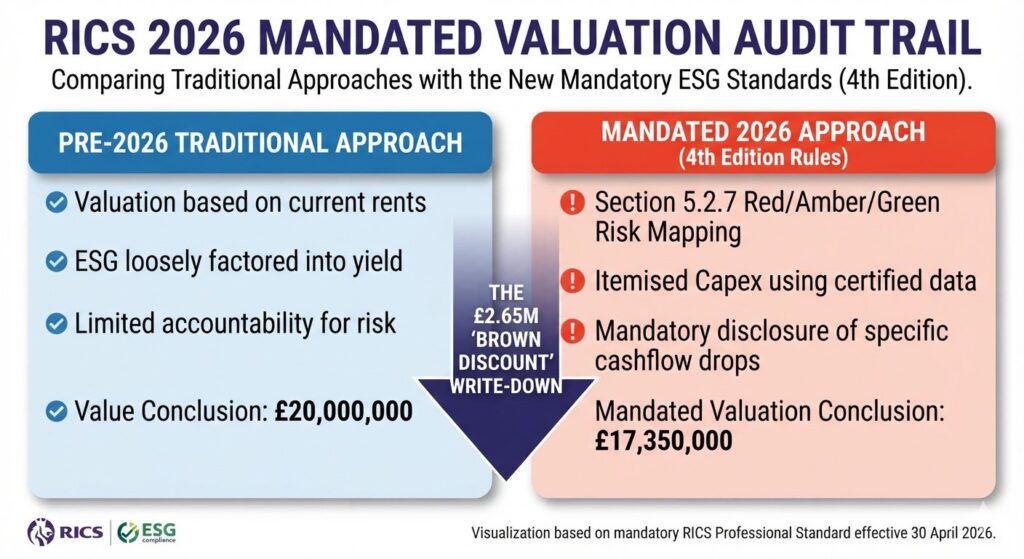
Before this year, a valuer might have looked at the current passing rent, noted the poor EPC rating as a vague “market risk,” and still valued the asset near its GBP 20M baseline.
Under the mandatory 2026 framework, the math shifts completely:
1. Mandated “Red” Risk Classification – Section 5.2.7
An EPC rating of F or G now automatically triggers a “Red” risk rating under the newly mandated reporting templates. The valuer is required to state in writing that the property is in immediate breach of UK MEES regulations, instantly flagging it as a toxic liability to institutional lenders.
2. Certified Capex Deductions – Section 3
Valuers are now forbidden from guessing retrofitting costs. To maintain an explicit audit trail, the valuer must use cost estimates prepared by a qualified construction professional. For this Birmingham asset, an exact capital deduction of GBP 850,000 is written into the cash flow: the certified cost required to upgrade the HVAC and fabric to lift the building to a compliant EPC Grade B.
3. Explicit Modeling of Void Periods – Section 4.6
Following the strict guidelines of Table 1 on ESG impacts on lettings, the valuer must benchmark the asset against compliant local peers. Because corporate occupiers now enforce strict net-zero targets, the valuer is forced to model an extended 12-month void and rent-free period upon upcoming lease expiries, stripping GBP 1,250,000 out of the near-term cash flow.
4. Yield Expansion & Professional Scepticism
Think a temporary 5-year exemption on the PRS Register will protect your asset’s value? Think again. The 2026 rules force valuers to apply strict professional scepticism, noting that a current exemption is not risk-free. To account for long-term liquidity risk, the capitalization yield expands from 6.25% to a risk-adjusted 6.75%.
This is how the new changes stack up:
– Pre-2026 Baseline Valuation: GBP 20,000,000
– Mandated 2026 Risk-Adjusted Value: GBP 17,350,000
– The “Brown Discount”: -GBP 2,650,000, down 13.25%
To my fellow real estate professionals: How are you seeing the April 2026 RICS rules impact your portfolios? Are you successfully managing the transition to avoid the “Red” classification with cost-effective means?
#RICS #ESG #CommercialProperty #PropertyValuation #SpaceMatch